Introduction
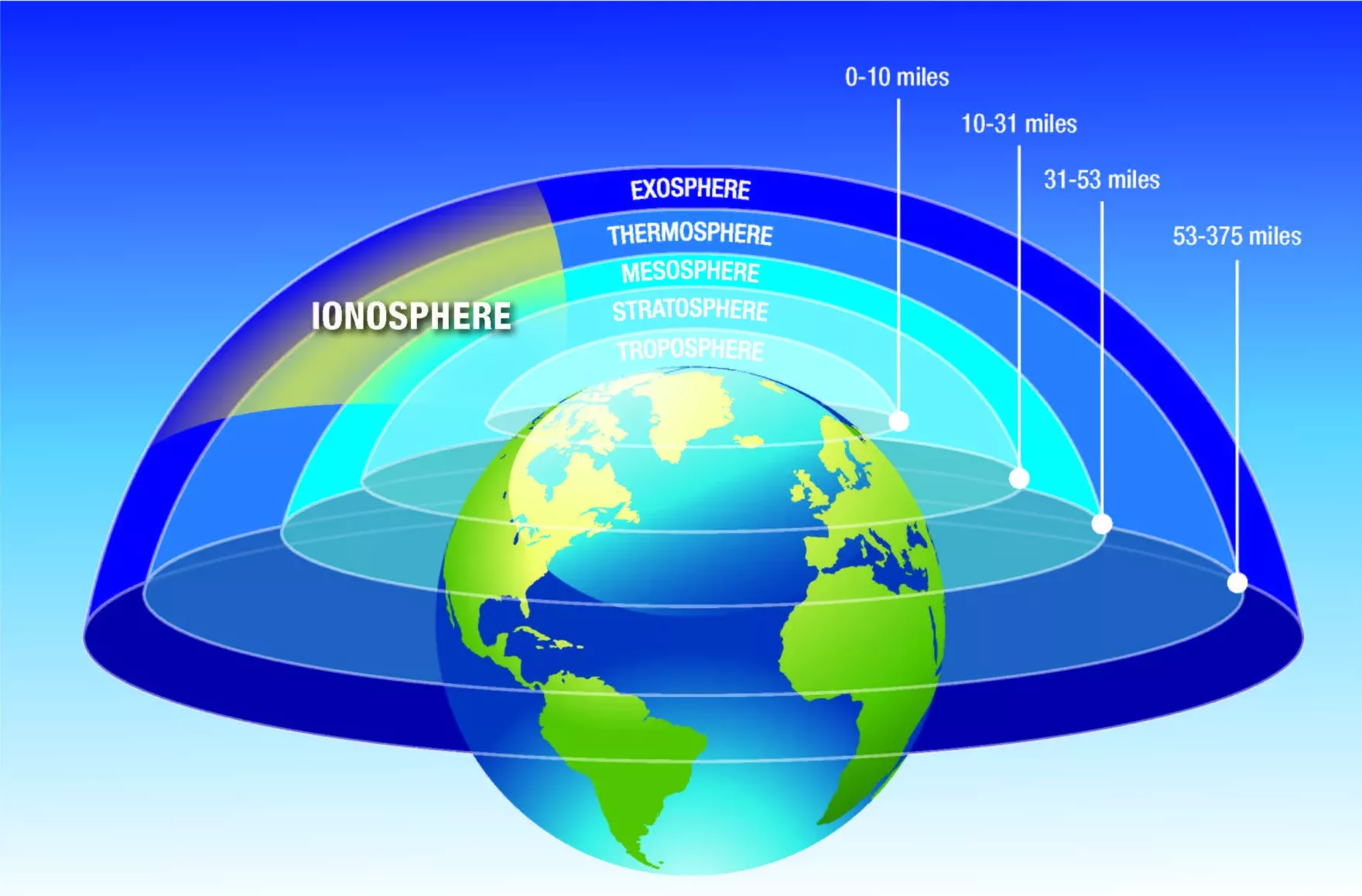
GPS accuracy depends on more than just satellite positions—the Earth's ionosphere plays a critical role in signal quality. The ionosphere, comprising the D, E, and F layers, is characterized by dynamic altitude changes throughout the day and across seasons, directly affecting how GPS signals reach receivers on the ground.
The Ionosphere: A Brief Overview
The ionosphere extends from approximately 48 kilometers to 965 kilometers above sea level and contains electrically charged particles created by solar radiation. This atmospheric region consists of three primary layers, each with distinct characteristics:
D Layer
The lowest ionospheric layer absorbs medium and lower high-frequency radio waves. This layer exists primarily during daylight hours and dissipates at night when solar radiation decreases.
E Layer
The middle layer reflects radio waves up to 50 MHz, particularly during intense sporadic events. Like the D layer, the E layer's density varies significantly between day and night.
F Layer
The highest and most important layer for GPS contains the greatest electron density and proves crucial for skywave radio propagation. During daylight, it splits into F1 and F2 sub-layers; at night, these layers merge into a single F layer.
GPS Signals and the Ionosphere
GPS satellites transmit signals on specific frequencies (L1 at 1575.42 MHz and L2 at 1227.60 MHz) that must traverse the ionosphere before reaching ground receivers. As signals pass through ionized particles, they experience refraction—bending and slowing—which introduces positioning errors.
Various models have been developed for compensating ionospheric effects on GPS signals. The Klobuchar model, implemented in most civilian GPS receivers, reduces ionospheric errors by approximately 50-60% using parameters broadcast in the GPS navigation message.
Factors Affecting Ionosphere Altitude
Three primary influences continuously alter ionospheric conditions:
1. Solar Activity
Fluctuations in solar radiation dramatically alter electron densities and layer altitudes. During peak solar activity (solar maximum), the ionosphere becomes more turbulent with higher electron densities, causing greater GPS signal delays. Conversely, solar minimum periods feature more stable, predictable ionospheric conditions.
2. Geomagnetic Activity
Earth's magnetic field interactions with charged solar particles cause structural changes in the ionosphere. Geomagnetic storms can trigger sudden ionospheric disturbances, temporarily degrading GPS accuracy across large geographic regions.
3. Disruptive Phenomena
Sudden ionospheric disturbances and polar cap absorption events create significant signal interference. These phenomena, often triggered by solar flares or coronal mass ejections, can cause rapid changes in ionospheric density over minutes to hours.
Impact on GPS Signal Quality
Changing ionospheric altitudes create several challenges for GPS accuracy:
Variable Signal Quality
As ionospheric density fluctuates throughout the day, GPS signals experience varying degrees of delay. Maximum delays typically occur during midday when solar radiation peaks, while nighttime conditions generally provide more stable signal propagation.
Frequency-Dependent Refraction
Different GPS frequencies experience different amounts of ionospheric delay. Dual-frequency receivers exploit this effect to calculate and remove most ionospheric errors, achieving significantly better accuracy than single-frequency receivers.
Elevation-Dependent Errors
Satellite elevation angles affect signal path length through the ionosphere. Signals from low-elevation satellites travel through more ionosphere, experiencing greater delays than signals from overhead satellites.
The Loko GPS Tracker Solution
Modern GPS trackers like the Loko compensate for ionospheric effects through multi-system integration:
- Multiple Satellite Systems: Access to GPS, GLONASS, and GALILEO provides redundant positioning data, improving accuracy when ionospheric disturbances affect individual satellite systems
- LoRa Radio Technology: Extended-range connectivity over 5 kilometers ensures position data reaches the receiver even when ionospheric conditions degrade satellite signal quality
- Robust Construction: Water, dust, and crash resistance ensures reliable operation regardless of environmental conditions
- Extended Battery Life: up to 1 year battery life at just 12 grams ensures continuous tracking without frequent recharging
Mitigating Ionospheric Effects
Several strategies help minimize ionospheric impacts on GPS accuracy:
- Use multi-frequency GPS receivers when precision positioning is critical
- Integrate multiple satellite constellations (GPS, GLONASS, GALILEO) for redundancy
- Apply ionospheric correction models like Klobuchar or more advanced algorithms
- Monitor space weather forecasts when planning activities requiring high GPS accuracy
- Avoid relying solely on low-elevation satellites, which experience greater ionospheric delays
Conclusion
Understanding ionospheric effects enables optimization of navigation systems for reliable performance despite atmospheric variations. While daily altitude changes in the ionosphere create challenges for GPS signal quality, modern receivers employ sophisticated correction algorithms and multi-constellation tracking to maintain accurate positioning.
For users of GPS tracking systems like the Loko GPS Tracker, the combination of multi-satellite integration and advanced signal processing ensures reliable location data even when ionospheric conditions fluctuate throughout the day. This resilience makes modern GPS technology dependable for applications from outdoor recreation to commercial fleet management.