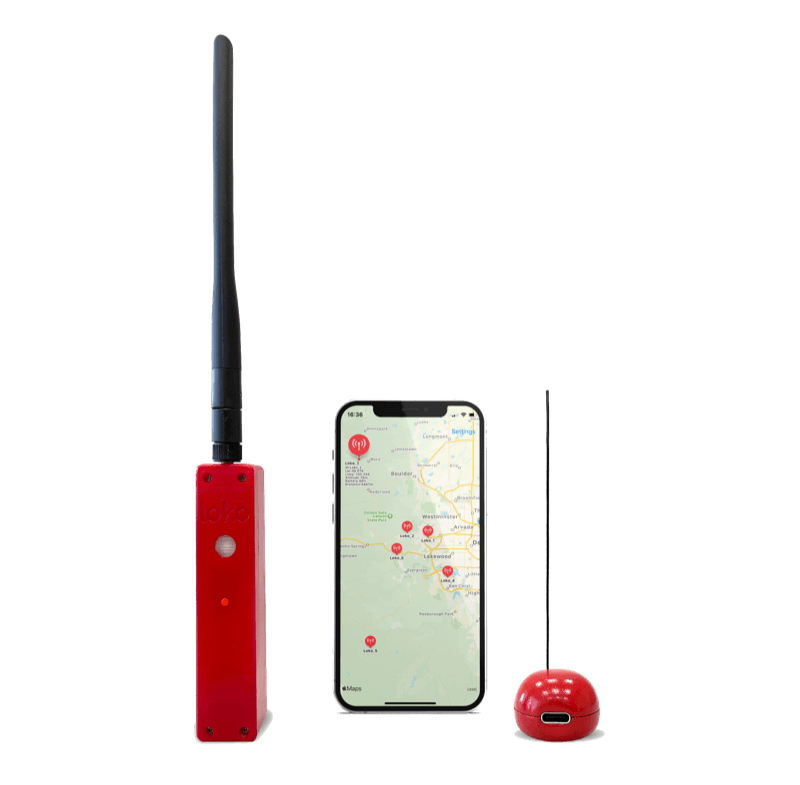
When people search for an offline GPS tracker, they usually mean one thing: a device that tells you where something is without relying on a cellular network, a SIM card, or monthly fees. This guide explains exactly how that works — and why LoRa radio makes it possible at ranges up to 20km.
Short answer: GPS itself already works offline. Loko keeps the rest of the chain offline too by sending location from the tracker to your receiver over LoRa P2P radio. If you are comparing products rather than studying the technology, start with the offline GPS tracker buying guide.
The Problem With Standard GPS Trackers
Most GPS trackers on the market are actually cellular GPS trackers. They determine their position via GPS satellites — which always work — but then transmit that position through a 4G or LTE cellular network to a cloud server. Your phone app retrieves the location from that server.
This architecture has two unavoidable consequences:
- No cell signal = no tracking. In forests, mountains, farmland, and remote areas, cellular coverage drops out. The tracker goes dark.
- Subscription fees. The cellular data link requires a SIM card and a monthly data plan. Typical cost: $5–$15 per month, indefinitely.
An offline GPS tracker eliminates both problems by replacing the cellular link with a direct radio connection.
How Offline GPS Tracking Actually Works
An offline GPS tracker has two separate systems inside it:
1. The GPS Positioning System
GPS (and its counterparts GLONASS, Galileo, BeiDou) works by receiving timed signals from satellites orbiting the Earth. The tracker calculates its position by measuring how long those signals take to arrive from multiple satellites. This is entirely passive — the tracker only receives signals, never transmits to the satellites. It works anywhere on the planet that has a clear view of the sky. No internet, no SIM, no infrastructure of any kind.
2. The Radio Data Link
The GPS position is only useful if you can receive it. An offline tracker needs a way to send the coordinates to you without going through a cellular network. This is where radio technology comes in.
Different radio technologies are used for this purpose:
| Technology | Range | Battery Life | Monthly Cost | Works Everywhere |
|---|---|---|---|---|
| LoRa P2P | Up to 20 km | Up to 1 year | $0 | Yes (no infra needed) |
| Cellular (4G/LTE) | Unlimited | 1–7 days | $5–$15 | No (needs cell coverage) |
| Satellite (Iridium) | Global | Days | $50–$200 | Yes (anywhere on Earth) |
| Bluetooth | ~100 m | Weeks | $0 | Very limited |
LoRa P2P occupies the optimal position for most use cases: long range, exceptional battery life, zero ongoing cost, and infrastructure-free operation.
What Is LoRa P2P and Why Does It Enable Offline Tracking?
LoRa stands for Long Range. It is a radio modulation technique — specifically chirp spread spectrum (CSS) — that encodes data by continuously sweeping radio frequency across a defined band. This sweep pattern makes LoRa signals highly resistant to noise and interference, allowing them to be decoded even when the received signal is far weaker than the background noise level.
LoRa P2P (peer-to-peer) means the tracker communicates directly with your receiver without any infrastructure — no gateway, no server, no network. The Loko GPS tracker sends its position directly to the LokoHUB receiver connected to your phone. The LokoHUB decodes the radio signal and forwards the coordinates to the Loko app.
The entire data path is:
- GPS satellites → Loko tracker (position calculation)
- Loko tracker → LokoHUB receiver (via LoRa radio, up to 20km)
- LokoHUB → Loko app on your phone (via Bluetooth or USB)
No cell tower. No cloud server. No internet. The location data never leaves this private loop.
Why LoRa Achieves 20km Range With a 1-Year Battery
LoRa's two key advantages — range and efficiency — come from the same source: chirp spread spectrum modulation spreads the signal energy over a wide bandwidth, making it extremely robust at very low power levels.
Range
A typical LoRa transmission power of 14–22 dBm (25–160 mW) can reach 20km in open terrain. A cellular radio transmitting at similar power barely covers a few hundred meters to the nearest tower. The difference is modulation: LoRa's spread spectrum encodes each bit across thousands of chips, giving the receiver enough signal processing gain to extract data from a signal that appears to be pure noise to conventional receivers.
Battery Life
LoRa transmissions are extremely short — typically 50–500 milliseconds per packet. Between transmissions, the radio chip draws near-zero current (sleep mode). At a 60-second update interval, the radio is active for less than 0.5% of the time. This duty cycle, combined with a 200 mAh battery, yields up to 1 year of operation for Loko. A cellular modem maintaining a continuous connection drains the same battery in hours.
Practical Implications: Who Needs an Offline GPS Tracker?
Offline GPS trackers are not the right tool for every situation. They are the right tool when:
- You operate outside cellular coverage — forests, mountains, farmland, remote wilderness
- You want zero ongoing costs — no subscription, ever
- Battery life matters — months or years, not days
- Privacy matters — your tracking data never passes through a third-party server
- You need redundancy — a backup tracker that works when your phone has no signal
Common use cases for Loko: hunting dogs and working dogs, farm equipment, drones, boats and kayaks in remote areas, personal safety on hiking and climbing expeditions, and high-value assets stored in locations without cell coverage.
Limitations of Offline GPS Tracking
Understanding what offline trackers cannot do is as important as knowing what they can:
- Range is finite. 20km is the maximum in ideal conditions. Dense forests and mountains reduce this. If the asset moves beyond radio range, you lose the signal.
- No real-time cloud access. The tracker reports to your LokoHUB receiver, not to a server. If you want to see the location from 500km away, LoRa P2P cannot provide that. (For multi-point access, LoRaWAN with a gateway can extend reach.)
- Line-of-sight dependent. Like all radio, LoRa performs best with a clear path between transmitter and receiver. Terrain and buildings reduce range.