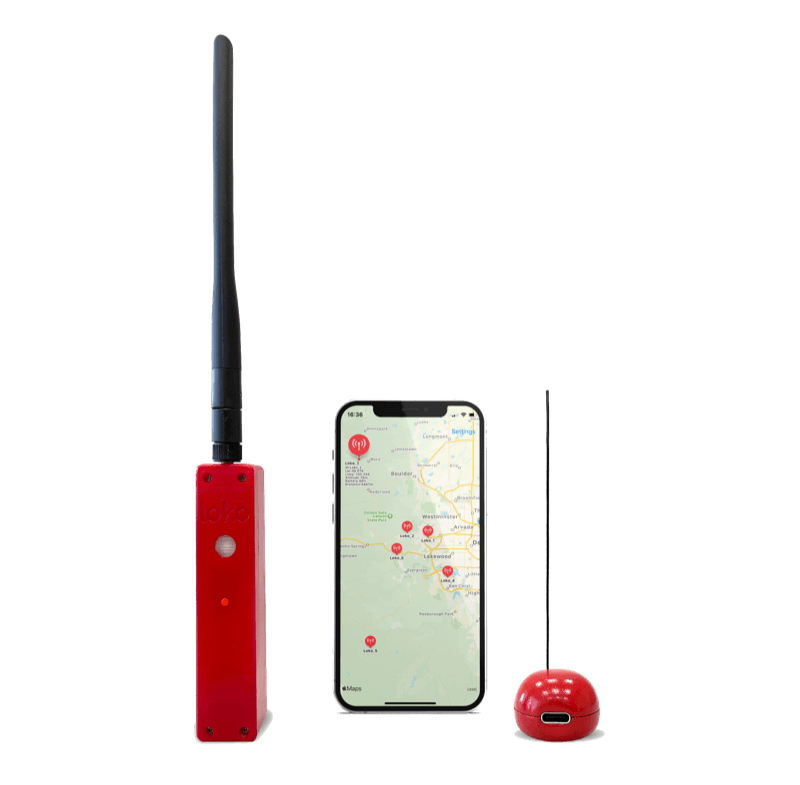
Most GPS dog collars rely on cellular networks. When your dog runs into a dead zone — a forest, a canyon, a remote field — the signal drops and you lose them. A LoRa GPS tracker for dogs solves this differently: instead of routing location data through a cell tower, it sends it directly to your handheld receiver using radio waves.
The result is a tracker that works everywhere, costs nothing per month, and runs for up to a year on a single charge.
Comparing devices? Start with the dog tracker without subscription comparison. Use this article for the radio technology and terrain details, or the hunting dog tracking page for hunting-specific use.
Why Cellular GPS Trackers Fail Hunting Dogs and Rural Pets
Standard GPS dog collars — brands like Tractive, Whistle, and Fi — require a SIM card and a live cellular connection to function. Their apps are excellent in cities, suburbs, and anywhere with reliable 4G coverage. But they have a fundamental limitation: if there's no cell signal, there's no tracking.
This is a serious problem for:
- Hunting dogs that range far into forests, swamps, and backcountry areas
- Farm dogs on large rural properties beyond the nearest cell tower
- Hiking dogs in mountains, national parks, or wilderness areas with no coverage
- Anyone outside Europe or North America where roaming fees make monthly GPS subscriptions unworkable
LoRa P2P (peer-to-peer) technology bypasses this problem entirely.
How LoRa Dog Tracking Works
LoRa stands for Long Range. It is a radio modulation technique that transmits small data packets — like GPS coordinates — over very long distances using very little power. Unlike cellular GPS, a LoRa tracker does not need infrastructure:
- The collar unit (on the dog) receives its location from GPS satellites
- It transmits that location via LoRa radio directly to your handheld receiver
- No cell tower, no SIM card, no internet connection is involved
The Loko GPS tracker uses LoRa P2P — a direct link between the collar and your receiver — rather than LoRaWAN, which requires a gateway. This means zero infrastructure. Loko works anywhere on Earth as long as there is radio line-of-sight between collar and receiver.
Loko Specifications for Dog Tracking
| Property | Loko | Typical Cellular GPS Collar |
|---|---|---|
| Weight | 14 g | 35–80 g |
| Dimensions | 28.5 × 20.5 × 5.9 mm | 50–100 mm long |
| Radio range | Up to 20 km (open terrain) | Unlimited (needs cell signal) |
| Range in forest | 2–5 km typical | 0 km (no coverage) |
| Battery life | Up to 1 year | 1–7 days |
| Monthly fee | $0 | $5–$15/month |
| Works without cell signal | Yes — always | No |
| GNSS systems | GPS + GLONASS + Galileo + BeiDou | Usually GPS only |
Real-World Range: What to Expect in Different Terrain
LoRa range depends heavily on terrain and line-of-sight conditions. Here is what Loko users typically report for dog tracking:
Open Fields and Farmland
In flat, open terrain with no significant obstacles, Loko reliably reaches 10–20 km. For farm dogs covering large properties, this means continuous tracking without gaps.
Forests and Dense Vegetation
Tree trunks and foliage absorb and scatter radio signals. In moderately dense forest, expect 2–5 km of reliable range. Raising your receiver (holding it up or placing it on a ridge) significantly extends coverage in wooded terrain.
Mountains and Valleys
Mountains provide excellent range when you have line-of-sight — tracking a dog across a valley from a ridge can exceed 15 km. Valleys without line-of-sight reduce range to 1–3 km. Cellular GPS trackers typically have zero signal in these same areas.
Hunting Scenarios
For bird dogs, hounds, and retrievers working in the field, LoRa delivers reliable contact at distances that exceed what most hunting parties cover in a day. Hunters report that Loko remains connected when cellular collars have long since lost signal.
Attaching Loko to a Dog Collar
Loko's compact form factor makes collar attachment straightforward. The device measures 28.5 × 20.5 × 5.9 mm — slightly larger than a 10-cent Euro coin — and weighs 14g. It fits any standard collar D-ring using the included mounting hardware.
Because Loko does not have its own display or controls, the companion app (available for iOS and Android) handles all configuration. You set the transmission interval (10 seconds to 5 minutes), and the collar unit operates autonomously from there.
Comparing Loko to GSM GPS Dog Collars
The right tracker depends on your use case:
- Choose a cellular GPS collar if your dog stays in suburban or urban areas with strong cell coverage, you want live tracking over any distance via a smartphone app, and monthly fees are acceptable
- Choose Loko (LoRa P2P) if your dog works in forests, farms, or mountains with unreliable cell coverage, you want tracking that works everywhere without a subscription, and battery life beyond 7 days is essential
For hunting dogs, working farm dogs, and rural pets, the cellular collar's subscription cost compounds over years: at $10/month, that is $120/year — more than Loko's purchase price. LoRa pays for itself in the first year and continues working for free indefinitely.
Frequently Asked Questions
Can I track my dog's location in real time with Loko?
Yes, in the sense that Loko transmits a fresh GPS position every 10–60 seconds (configurable). The location appears in the Loko app on your phone. Unlike cellular GPS apps, the Loko app communicates with the collar directly via the LokoHUB receiver connected to your phone — not through a cloud server.
Does Loko work if my dog goes underground or into a burrow?
No GPS tracker — LoRa or cellular — can provide reliable tracking inside dense earth or underground. GPS signals cannot penetrate solid ground. For surface-level tracking in open or lightly wooded terrain, Loko performs excellently.
Is Loko waterproof for dogs that swim?
Loko has an IP rating for splash resistance. For dogs that regularly swim or are submerged, confirm the latest waterproofing specifications at the specifications page before purchase.